
How to Answer Common Interview Questions “Most job interviews, regardless of industry or seniority level, circle back to a familiar set of questions. Yet candidates still walk in underprepared for them, not because the questions are difficult, but because they haven’t thought through how to answer them clearly and specifically in advance. Learning how to answer common interview questions well isn’t about memorizing scripts. It’s about understanding what each question is actually trying to uncover, and preparing genuine, structured answers around that. Here’s a complete, practical guide.
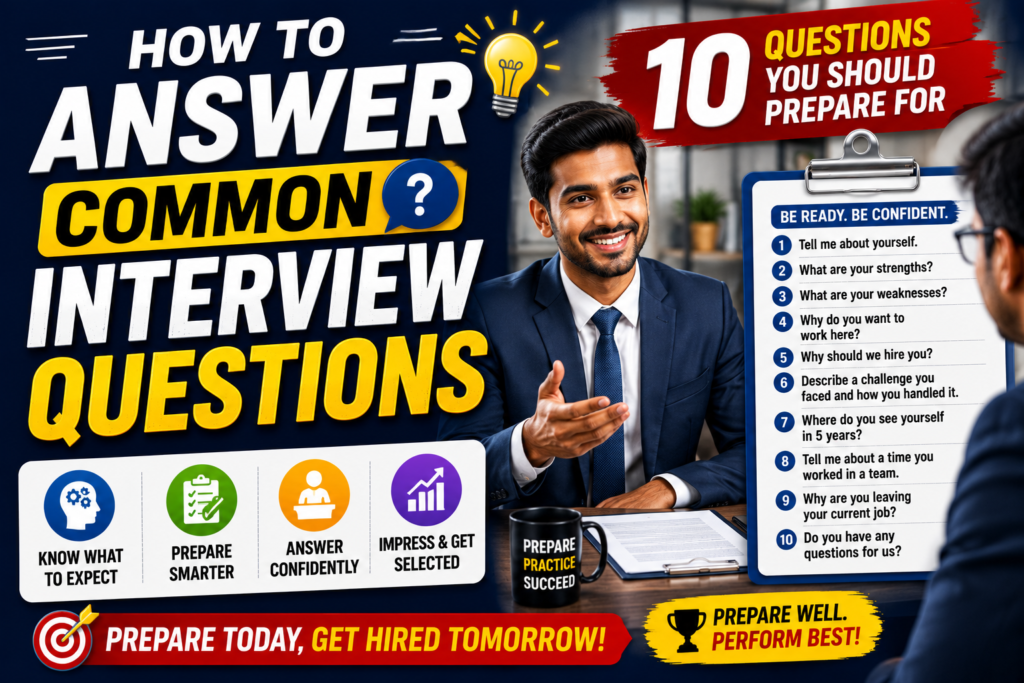
Table of Contents
Quick Overview: The Principle Behind Every Common Question
| What Interviewers Ask | What They’re Actually Trying to Learn |
|---|---|
| “Tell me about yourself” | Can you communicate your professional story clearly and relevantly? |
| “Why do you want this role?” | Is your interest genuine, or are you applying everywhere indiscriminately? |
| “What are your strengths/weaknesses?” | Do you have honest self-awareness? |
| “Describe a challenge you overcame” | How do you actually behave under pressure or difficulty? |
| “Where do you see yourself in 5 years?” | Are your goals reasonably aligned with this role and company? |
Every common interview question exists to reveal something specific about you as a candidate. Once you understand what’s actually being assessed, crafting a strong answer becomes far more straightforward than trying to guess what the “right” response sounds like.
Question 1: “Tell Me About Yourself”
This is usually the opening question, and it sets the tone for the rest of the interview, yet it’s one of the most commonly mishandled. Candidates often either recite their entire life story or give an answer so vague it says nothing useful.
A strong approach follows a simple structure: briefly cover your current or most recent role, highlight one or two relevant achievements or skills, and connect it directly to why you’re interested in this specific opportunity. Keep it to about 60 to 90 seconds. This isn’t the moment for your complete biography, it’s a focused professional summary that sets up the rest of the conversation.
Question 2: “Why Do You Want to Work Here?”
This question specifically tests whether you’ve done genuine research on the company, or whether you’re sending the same generic application everywhere. A vague answer like “I’ve heard great things about the company” signals minimal preparation.
A stronger answer references something specific, a product, a company value, a recent development, or a particular aspect of the role, and connects it to your own skills or career direction. Even one specific, well-researched detail can meaningfully differentiate your answer from a generic one.
Question 3: “What Are Your Strengths?”
The temptation here is to list generic, overused traits like “hardworking” or “team player” without any supporting evidence. A stronger answer picks one or two strengths genuinely relevant to the role you’re applying for, and backs each one with a brief, specific example demonstrating it in action, rather than just asserting the trait.
Question 4: “What Is Your Biggest Weakness?”
This question makes many candidates uncomfortable, leading to either an obviously fake weakness disguised as a strength (“I work too hard”) or an overly damaging admission that raises real concern. The better approach is genuine but strategic: name an actual, real weakness that isn’t central to the core requirements of the role, and pair it with a specific example of how you’re actively working to improve it. This shows honest self-awareness alongside a growth mindset, which is really what this question is trying to assess.
Question 5: “Describe a Challenge You Overcame”
This is a behavioral question, and behavioral questions are best answered using a structured format rather than a rambling narrative. The STAR method works well here:
| STAR Component | What to Cover |
|---|---|
| Situation | Briefly set the context |
| Task | What specifically needed to be done or solved |
| Action | What you personally did, be specific |
| Result | The outcome, ideally with a measurable or clear impact |
Using this structure keeps your answer focused and prevents it from wandering into unnecessary detail, while still giving the interviewer everything they need to assess how you actually think and act under pressure. This structured approach to behavioral interviewing is widely referenced in career guidance from sources like the <a href=”https://www.ncs.gov.in” rel=”dofollow” target=”_blank”>National Career Service portal</a>, which offers general interview preparation resources for job seekers across India.
Question 6: “Why Are You Leaving Your Current Job?” (or “Why Did You Leave Your Last Job?”)
This question requires care, since speaking negatively about a previous employer, manager, or team almost always reflects poorly on the candidate, regardless of how justified the frustration might genuinely be. A stronger approach focuses forward rather than backward: framing your answer around what you’re looking for next, growth, new challenges, a better fit for your skills, rather than what you’re running away from.
Question 7: “Where Do You See Yourself in 5 Years?”
This question checks whether your career direction is reasonably aligned with the role and the company’s growth path, not whether you have your entire career mapped out with precision. A good answer expresses genuine ambition and a general direction, while staying flexible enough to sound realistic rather than rigidly scripted.
Question 8: “Why Should We Hire You?”
This is your most direct opportunity to summarize your value proposition clearly. A strong answer connects your specific skills and experience directly to the role’s core requirements, ideally referencing one or two concrete examples, rather than repeating generic claims about being a hard worker or fast learner without evidence behind them.
Question 9: “Do You Have Any Questions for Us?”
This is not a formality to skip. Not asking any questions at all can signal a lack of genuine interest or preparation. Prepare two or three thoughtful questions in advance, ideally about the role’s day-to-day responsibilities, team structure, or growth opportunities, rather than questions you could have easily answered yourself through basic research, like the company’s founding year.
Question 10: “What Are Your Salary Expectations?”
This question often catches candidates off guard, especially if it’s asked early in the process. Where possible, it’s reasonable to redirect gently, expressing interest in first understanding the full scope of the role before discussing specific numbers. If you do need to give a range, base it on genuine market research for your role, experience, and location, rather than an arbitrary guess.
A Simple Framework for Preparing Any Common Question
Rather than memorizing scripted answers word for word, which often comes across as stiff or rehearsed, it helps to prepare using a flexible framework:
- Identify what the question is actually trying to assess, using the overview table above as a starting reference
- Choose one or two specific, real examples from your actual experience that demonstrate the relevant quality
- Structure your answer briefly, using something like the STAR method for behavioral questions
- Practice out loud, not just mentally, so your delivery sounds natural rather than recited
This approach adapts naturally to slight variations in how a question is phrased, rather than falling apart the moment an interviewer asks something slightly different from what you memorized.
Common Mistakes When Answering Interview Questions
- Giving vague, generic answers without specific examples to back them up
- Speaking negatively about a previous employer, manager, or company
- Rambling without a clear structure, especially for behavioral questions
- Reciting memorized answers so rigidly that natural conversation breaks down
- Not preparing any questions to ask the interviewer at the end
- Answering the salary question with an arbitrary number instead of researched figures
Interview Preparation Checklist
- Prepared a concise, structured answer for “Tell me about yourself”
- Researched the company enough to answer “why this company” specifically
- Identified 2 to 3 genuine strengths with supporting examples
- Prepared an honest weakness paired with active improvement efforts
- Practiced at least one challenge/achievement story using the STAR method
- Prepared a forward-focused answer for why you’re leaving your current role
- Prepared 2 to 3 genuine questions to ask the interviewer
- Researched a realistic salary range for the role, experience level, and location
Who This Guide Is Especially Useful For
This preparation approach works well whether you’re interviewing for your first job, switching industries, or interviewing at a senior level, since the underlying principle, understanding what each question is really assessing and preparing specific, honest answers, applies consistently across experience levels. It’s particularly useful for candidates who’ve felt caught off guard by these exact questions in past interviews.
Related Reads on FreshJobSeekers
- Deloitte USI Recruitment 2026: Intela Support Associate Services Specialist I, Hyderabad
- Wipro Graduate Engineer Trainee Recruitment 2026: Freshers Can Apply
- Microworkers.com Review: What India Based Users Should Actually Expect
- Frontier Customer Support Representative: Remote Overnight Project Role Explained
- Startek Zomato WFH Customer Support Executive: Chat and Voice Process Hiring
Frequently Asked Questions About How to Answer Common Interview Questions
1. Should I memorize exact answers to common interview questions?
It’s better to prepare a flexible structure and specific examples rather than memorizing word-for-word scripts, which can sound stiff and fall apart if the question is phrased slightly differently.
2. How long should my answer to “Tell me about yourself” be?
Around 60 to 90 seconds is generally ideal, focused and relevant rather than a complete life history.
3. What is the STAR method?
It’s a structured way to answer behavioral questions, covering Situation, Task, Action, and Result, helping keep your answer focused and complete.
4. Is it okay to say I don’t have any weaknesses?
No, this generally comes across as lacking self-awareness. A genuine, non-critical weakness paired with active improvement efforts is a much stronger answer.
5. How do I answer “why are you leaving your job” without sounding negative?
Focus your answer on what you’re moving toward, growth, new challenges, better fit, rather than criticizing your current or previous employer.
6. Is it necessary to ask questions at the end of an interview?
Yes, not asking any questions can signal a lack of genuine interest or preparation, so having a few thoughtful questions ready is important.
7. How should I handle the salary expectations question if asked early?
Where possible, it’s reasonable to redirect gently, expressing interest in understanding the full role first, though some situations require giving a range upfront.
8. What if I genuinely don’t know where I’ll be in 5 years?
It’s fine to express general direction and ambition rather than a precise plan, as long as it sounds reasonably aligned with the role you’re applying for.
9. How many examples should I prepare in advance for behavioral questions?
Having 3 to 4 versatile examples ready, which can be adapted to different specific questions, is generally sufficient preparation.
10. Should my answers be different for a government job interview versus a private company interview?
The core preparation principles are similar, though government interviews often place additional emphasis on integrity, current affairs awareness, and public accountability compared to private sector interviews.
11. What’s the biggest mistake candidates make when answering these questions?
Giving vague, generic answers without specific, real examples to support them.
12. Should I practice answering these questions out loud, or just think through them mentally?
Practicing out loud is significantly more effective, since it reveals gaps in your answer and helps your delivery sound natural rather than rehearsed.
Final Thoughts
Learning how to answer common interview questions well comes down to understanding the intent behind each question and preparing genuine, structured, specific answers in advance. None of this requires memorizing scripts or sounding artificially polished, it requires honest self-reflection paired with a bit of structure, so your real experience and strengths come through clearly under the pressure of an actual interview. Candidates who prepare this way consistently come across as more confident and credible than those relying on generic, on-the-spot answers.
Disclaimer
This article has been published by FreshJobSeekers for general informational and educational purposes only. It reflects general best practices for interview preparation based on widely recognized hiring patterns, and is not a guarantee of interview success or job offers. Actual interview formats and expectations vary across industries, companies, and specific roles.
FreshJobSeekers is not affiliated with any specific employer or recruitment platform mentioned or implied in this article. We do not guarantee that following this guide will result in any specific interview outcome. Readers are encouraged to adapt the suggestions here to their own industry, role, and the specific expectations of the companies they are interviewing with. We do not charge any fee for the career guidance published on this site.