Full Stack Developer Roadmap 2026 : Full stack development remains one of the most in-demand and versatile career paths in tech, but the sheer number of tools, frameworks, and languages out there can make it genuinely confusing to know where to start. A clear full stack developer roadmap cuts through that noise, giving you a structured, logical sequence to follow rather than jumping randomly between tutorials. Here’s a complete, practical roadmap for building full stack development skills from the ground up.
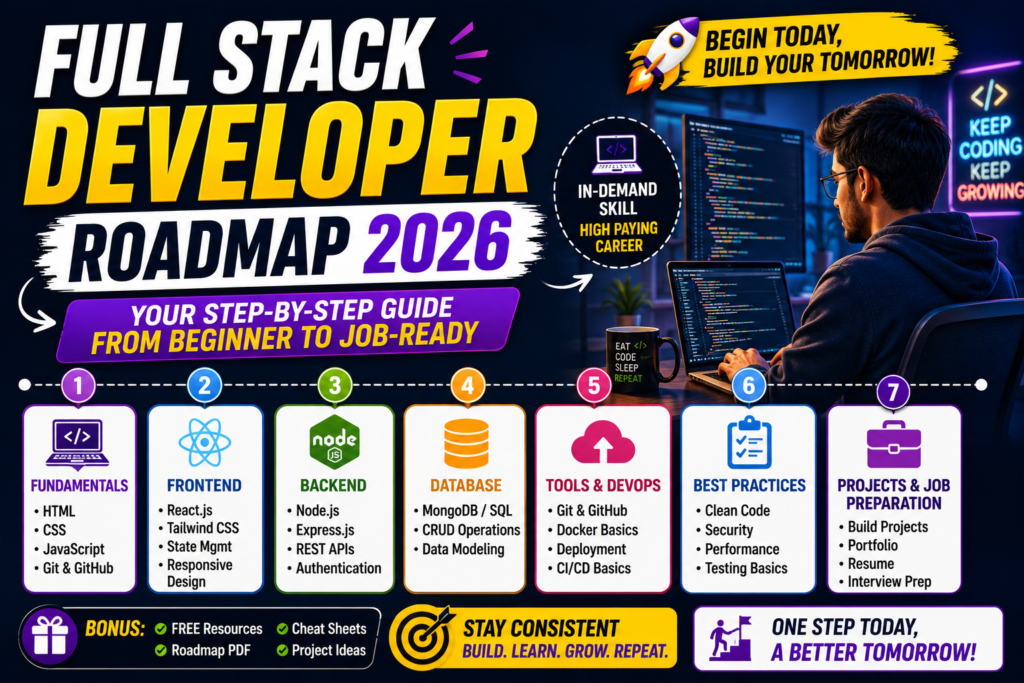
Table of Contents
Quick Overview: Full Stack Developer Roadmap 2026 Roadmap at a Glance
| Stage | Focus Area | Approximate Time Investment |
|---|---|---|
| 1 | HTML, CSS, and Web Fundamentals | 3 to 4 weeks |
| 2 | JavaScript Fundamentals | 4 to 6 weeks |
| 3 | Frontend Framework (React, Vue, or Angular) | 6 to 8 weeks |
| 4 | Version Control with Git and GitHub | 1 to 2 weeks (ongoing practice) |
| 5 | Backend Development (Node.js, Python, or Java) | 6 to 8 weeks |
| 6 | Databases (SQL and NoSQL) | 4 to 5 weeks |
| 7 | APIs and Authentication | 3 to 4 weeks |
| 8 | Deployment and Cloud Basics | 3 to 4 weeks |
| 9 | Testing and Debugging | 2 to 3 weeks (ongoing practice) |
| 10 | Building Real Projects and Portfolio | Ongoing, throughout |
This timeline is a general guide, not a fixed rule. Your actual pace will depend on prior programming experience, how much time you can dedicate daily, and how deeply you choose to explore each topic.
What Does “Full Stack” Actually Mean?
A full stack developer works across both the frontend, what users actually see and interact with in their browser, and the backend, the server-side logic, databases, and infrastructure that power the application behind the scenes. Being “full stack” doesn’t mean mastering every single technology equally. It means having solid, functional competence across the entire application flow, from a button click on screen to the database query that responds to it.
This breadth is exactly what makes full stack developers valuable to smaller teams and startups especially, where a single person often needs to handle multiple layers of an application rather than working in a narrowly specialized silo.
Stage 1: Master HTML, CSS, and Web Fundamentals
Every full stack developer roadmap has to start here, regardless of which frameworks or languages you eventually specialize in. HTML structures web content, and CSS controls how it looks and is laid out. Beyond just the basics, focus on genuinely understanding:
- Semantic HTML, using the right elements for the right purpose
- CSS layout systems, particularly Flexbox and CSS Grid
- Responsive design principles, so your work displays properly across devices
- Basic accessibility principles, since this affects real usability
Skipping past this foundation to jump straight into a framework is one of the most common mistakes beginners make. Frameworks build on these fundamentals, they don’t replace the need to understand them.
Stage 2: Learn JavaScript Thoroughly
JavaScript is the language that makes web pages interactive, and it’s foundational to nearly everything else in this roadmap, including most frontend frameworks and one major backend approach (Node.js). Spend real time here rather than rushing through it, focusing on:
- Core syntax, variables, functions, and control flow
- DOM manipulation, understanding how JavaScript interacts with web page elements
- Asynchronous JavaScript, including promises and async/await, since this trips up many beginners
- ES6+ features, like arrow functions, destructuring, and modules, which are used constantly in modern codebases
A genuinely strong grasp of JavaScript fundamentals makes every subsequent stage of this roadmap significantly easier to learn.
Stage 3: Pick a Frontend Framework and Go Deep
Once your JavaScript fundamentals are solid, it’s time to learn a frontend framework or library. The three most common options are React, Vue, and Angular, and while there are genuine technical differences between them, for a beginner’s roadmap, the specific choice matters less than developing real depth in whichever one you pick.
| Framework | General Reputation |
|---|---|
| React | Currently the most widely adopted in the job market, with a large ecosystem and community |
| Vue | Known for a gentler learning curve, popular in certain regions and among smaller teams |
| Angular | A more opinionated, full-featured framework, common in larger enterprise codebases |
Whichever you choose, focus on genuinely understanding component-based architecture, state management, and how data flows through an application, rather than just memorizing syntax for a specific framework.
Stage 4: Learn Git and Version Control Early
This deserves its own dedicated stage, since it’s easy to underestimate how essential Git is until you’re actually working on real projects, especially with other people. Learn the fundamentals of Git early and use it consistently from your very first practice projects onward:
- Basic commands: commit, push, pull, branch, merge
- Working with GitHub or GitLab for hosting and collaboration
- Writing clear, meaningful commit messages
- Understanding and resolving basic merge conflicts
Git isn’t a separate “extra” skill to learn later, it’s something you should be using throughout every other stage of this roadmap, not saved for the end.
Stage 5: Learn Backend Development
This is where you build the server-side logic that powers your applications. The most common backend paths for full stack developers are:
| Backend Path | Common Language/Framework |
|---|---|
| JavaScript-based backend | Node.js with Express.js |
| Python-based backend | Django or Flask |
| Java-based backend | Spring Boot |
Choosing Node.js has one practical advantage for beginners specifically: it lets you use JavaScript across both frontend and backend, reducing the number of entirely new languages you need to learn at once. That said, Python and Java backends remain extremely widely used in the industry, so this choice should also factor in the kind of roles and companies you’re eventually targeting.
Core backend concepts to focus on regardless of language include routing, middleware, handling requests and responses, and structuring a server-side application logically.
Stage 6: Understand Databases
Applications need somewhere to store and retrieve data, and this stage covers both major database categories:
- Relational (SQL) databases, like PostgreSQL or MySQL, using structured tables and relationships, essential for most traditional applications
- Non-relational (NoSQL) databases, like MongoDB, storing more flexible, document-based data structures, common in modern web applications
Rather than trying to master every database technology available, focus on genuinely understanding one SQL database and one NoSQL database well, including how to design schemas, write queries, and understand when each type is more appropriate for a given use case.
Stage 7: Learn APIs and Authentication
Modern applications are built around APIs, the mechanisms that let your frontend, backend, and often third-party services communicate with each other. This stage covers:
- Building and consuming RESTful APIs
- Understanding HTTP methods and status codes properly
- Implementing authentication and authorization, commonly using JWT (JSON Web Tokens) or session-based approaches
- Basic API security practices, like input validation and rate limiting
This stage is where your frontend and backend knowledge genuinely start connecting into complete, functional applications.
Stage 8: Learn Deployment and Basic Cloud Concepts
A project sitting only on your local machine isn’t truly complete until you understand how to deploy it so others can actually access it. This stage includes:
- Deploying frontend applications, commonly through platforms like Vercel or Netlify
- Deploying backend applications and databases, commonly through platforms like Render, Railway, or a cloud provider like AWS
- Basic understanding of environment variables and configuration management
- An introduction to containerization concepts, like Docker, which is increasingly expected even at junior levels
You don’t need deep cloud infrastructure expertise at this stage, but genuine familiarity with getting a project live and accessible is an important, often underestimated skill.
Stage 9: Learn Testing and Debugging Practices
Many beginner roadmaps skip this stage entirely, which is a mistake. Understanding how to test and debug your own code properly is a skill that separates genuinely job-ready developers from those who can only build features that work under ideal conditions. Focus on:
- Writing basic unit tests for your functions and components
- Using browser developer tools effectively for frontend debugging
- Reading and interpreting error messages and stack traces methodically, rather than guessing randomly
Stage 10: Build Real Projects and a Portfolio
This isn’t really a separate “final stage,” it should be happening continuously throughout every stage above. Real, deployed projects are what actually demonstrate your skills to employers, far more convincingly than certificates or completed tutorials alone.
A strong beginner portfolio typically includes:
- A few small, focused projects demonstrating specific skills, like a REST API or a responsive frontend component
- At least one larger, complete full stack project, ideally solving a genuine, specific problem rather than another generic to-do list clone
- Clean, well-documented code hosted on GitHub, with clear commit history
- Live, deployed versions of your projects that recruiters can actually visit and interact with
Common Mistakes to Avoid on This Roadmap
- Jumping straight into a framework without solid HTML, CSS, and JavaScript fundamentals first
- Watching tutorials passively without building any original projects of your own
- Trying to learn every framework and language simultaneously instead of going deep on one path at a time
- Skipping Git and version control until “later,” then struggling with it during actual collaborative work
- Neglecting deployment, ending up with projects that only run locally and were never shown live to anyone
- Avoiding testing and debugging practice, then struggling significantly once working on larger, real world codebases
Full Stack Developer Learning Checklist
- Comfortable building responsive layouts with HTML, CSS, Flexbox, and Grid
- Solid understanding of core JavaScript, including asynchronous concepts
- Built multiple projects using a frontend framework (React, Vue, or Angular)
- Comfortable using Git and GitHub for version control
- Built a backend application handling routing, middleware, and requests
- Comfortable working with both a SQL and a NoSQL database
- Built and consumed RESTful APIs, including authentication
- Successfully deployed at least one full stack project live
- Written basic tests and practiced structured debugging
- Have a portfolio with real, documented, deployed projects
Career Path and Opportunities
Full stack developers are consistently in demand across startups, mid-sized companies, and large enterprises in India, given their ability to contribute across multiple layers of a product. Career progression commonly moves from Junior/Associate Full Stack Developer toward Full Stack Developer, Senior Developer, and eventually specialized paths like Tech Lead, Solutions Architect, or Engineering Manager, depending on individual interest in technical depth versus people management.
Compensation for full stack roles in India varies significantly based on company size, location, and specific technology stack, so rather than citing a specific figure here that could quickly become outdated, we’d recommend checking current listings on major job platforms for roles matching your specific experience level and target companies for the most accurate, current picture.
Who This Roadmap Is Especially Useful For
This roadmap works well for complete beginners starting from scratch, students supplementing their formal education with practical project-based skills, and professionals transitioning into tech from a different field. The sequence and pacing can be adjusted based on your starting point, but the underlying order, fundamentals before frameworks, frontend and backend before deployment, deployment before advanced testing, remains a sound structure regardless of your starting experience level.
Related Reads on FreshJobSeekers
- Deloitte USI Recruitment 2026: Intela Support Associate Services Specialist I, Hyderabad
- Wipro Graduate Engineer Trainee Recruitment 2026: Freshers Can Apply
- Microworkers.com Review: What India Based Users Should Actually Expect
- Frontier Customer Support Representative: Remote Overnight Project Role Explained
- Startek Zomato WFH Customer Support Executive: Chat and Voice Process Hiring
Frequently Asked Questions About the Full Stack Developer Roadmap
1. How long does it take to become a full stack developer?
This varies significantly based on prior experience and daily time commitment, but a realistic, consistent effort typically takes anywhere from 6 months to a year to reach a genuinely job-ready level.
2. Should I learn React, Vue, or Angular first?
React currently has the widest adoption in the job market, making it a reasonable default choice, though Vue’s gentler learning curve or Angular’s structure may suit some learners better depending on personal preference and target companies.
3. Do I need to learn both SQL and NoSQL databases?
Genuine familiarity with at least one of each is valuable, since different projects and companies favor different approaches depending on their specific data needs.
4. Is Node.js better than Python or Java for the backend?
Not inherently better, but using JavaScript across both frontend and backend reduces the number of new languages a beginner needs to learn simultaneously, which is a practical advantage early on.
5. Do I need a computer science degree to become a full stack developer?
No, many successful full stack developers are self-taught or come from bootcamps, though a genuinely strong, demonstrated skill set through real projects matters more than the specific educational path.
6. How important are personal projects compared to tutorials?
Personal projects are significantly more important. Tutorials teach concepts, but building original projects is what actually demonstrates and solidifies genuine skill to employers.
7. Should I learn TypeScript as part of this roadmap?
While not covered as a separate mandatory stage here, TypeScript has become increasingly common in professional environments, and learning it after establishing solid JavaScript fundamentals is a reasonable next step.
8. Is Git really necessary, or can I skip it as a beginner?
It’s genuinely necessary, not optional. Nearly all professional development work relies on version control, and learning it early prevents significant struggle later during collaborative or team-based work.
9. What’s the biggest mistake beginners make on this roadmap?
Jumping into frameworks and advanced topics without solidifying HTML, CSS, and JavaScript fundamentals first, which creates gaps that cause confusion later.
10. Do I need to learn cloud platforms like AWS in depth?
Not necessarily in depth as a beginner, but basic familiarity with deploying applications and understanding cloud fundamentals is genuinely expected even at junior levels.
11. How many projects should be in my portfolio before applying for jobs?
A reasonable target is a few smaller, focused projects plus at least one complete, deployed full stack project that solves a genuine, specific problem.
12. Can I follow this roadmap while working a full-time job?
Yes, many people do, though the timeline will naturally extend based on available daily or weekly study time, consistency matters more than speed.
Final Thoughts
A structured full stack developer roadmap turns an overwhelming list of technologies into a manageable, sequential learning path. Starting with solid fundamentals, progressing deliberately through frontend, backend, databases, and deployment, and building real, deployed projects throughout, rather than saving them for the end, gives you both the genuine skills and the tangible proof of those skills that employers are actually looking for. The specific tools and frameworks will keep evolving, but this underlying structure remains a reliable way to approach the learning journey.
Disclaimer
This article has been published by FreshJobSeekers for general informational and educational purposes only. It reflects a general, widely recognized approach to full stack development learning paths, and is not a guarantee of employment, interview success, or any specific career outcome. Technology trends, frameworks, and industry demand can shift over time, so readers should supplement this roadmap with current research on tools and frameworks relevant to their specific target roles.
FreshJobSeekers is not affiliated with any specific framework, platform, or company mentioned in this article. We do not guarantee that following this roadmap will result in any specific hiring or salary outcome. Readers are encouraged to adapt the pacing and technology choices here to their own learning style, prior experience, and career goals. We do not charge any fee for the career guidance published on this site.