
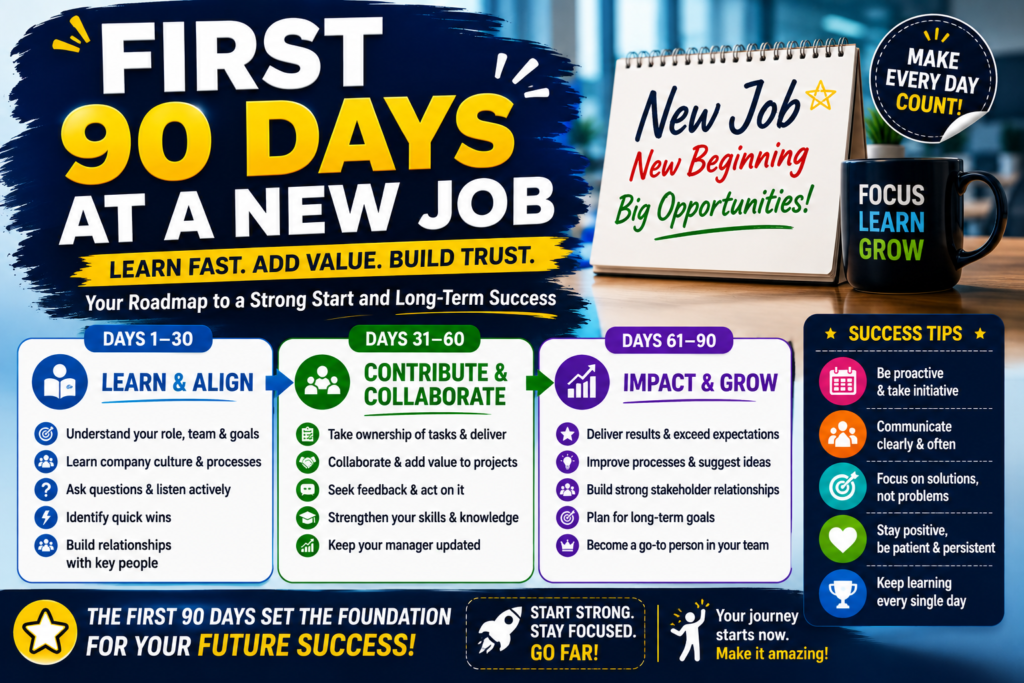
Landing the job is one milestone. What you do in your first 90 days at a new job is a completely different one, and it often quietly determines how the rest of your time at that company unfolds. Many new hires either coast on early enthusiasm without a real plan, or overcorrect by trying to prove themselves too aggressively too soon. Neither approach tends to work well. Here’s a complete, practical guide to navigating this critical window with intention.
Table of Contents
Quick Overview: What the First 90 Days Are Actually For
| Phase | Rough Timeline | Primary Focus |
|---|---|---|
| Orientation | Days 1 to 30 | Learning systems, people, and expectations |
| Contribution | Days 31 to 60 | Taking on real ownership and delivering initial results |
| Integration | Days 61 to 90 | Building deeper relationships and identifying growth areas |
This isn’t a rigid formula, timelines shift depending on your role, industry, and how structured your company’s onboarding actually is. But thinking in these three broad phases helps you avoid two common traps: trying to have all the answers on day one, or drifting through the whole quarter without a clear sense of progress.
Why the First 90 Days Matter More Than People Realize
Most managers and colleagues form a lasting impression of a new hire well before the 90-day mark, often within the first few weeks. This isn’t entirely fair, but it’s a genuine pattern worth planning around. How you show up early tends to shape how much trust, autonomy, and opportunity you’re given later, since early impressions are notoriously sticky and hard to fully reverse once formed.
Beyond other people’s perceptions, this window is also when you’re forming your own foundational understanding of how the company actually works, its unwritten norms, its real priorities versus its stated ones, and where the actual decision-making happens. Getting this foundation right early makes everything that follows easier. General workplace readiness resources, such as those available through the <a href=”https://www.ncs.gov.in” rel=”dofollow” target=”_blank”>National Career Service portal</a>, also touch on the importance of structured onboarding for long-term job satisfaction.
Phase 1 (Days 1 to 30): Focus on Learning, Not Proving
The instinct to immediately demonstrate value is understandable, but the first month is genuinely better spent absorbing context than pushing big ideas or major changes. Companies rarely expect dramatic contributions in week one, what they do notice is whether you’re asking good questions, listening carefully, and building an accurate picture of how things actually work.
Learn the People Before the Processes
Identify who the key people are, not just your direct manager, but the colleagues whose work intersects with yours, and anyone whose informal influence matters more than their formal title suggests. Understanding the human landscape of an organization is often more useful in the long run than memorizing every process document on day one.
Ask Genuinely Curious Questions
There’s a narrow but real window early on where asking questions is expected and welcomed, rather than seen as a lack of competence. Use it. Questions like “What does success look like in this role after six months?” or “What’s the biggest challenge the team is currently facing?” signal genuine engagement, and the answers give you a much clearer picture of what actually matters here versus what’s just on paper.
Understand the Real Priorities, Not Just the Stated Ones
Every organization has some gap between its official processes and how work actually gets done in practice. Spend your first month observing this gap rather than assuming the employee handbook tells the whole story. Notice which meetings people actually prepare for versus which ones are treated as formalities, and which metrics leadership genuinely cares about versus which ones are mentioned but rarely acted on.
Phase 2 (Days 31 to 60): Start Taking Real Ownership
By the second month, the balance should shift meaningfully from observing toward contributing. This is when you start taking on genuine responsibility, delivering initial results, and demonstrating that the trust placed in you during hiring was justified.
Identify an Early Win, Realistically Scoped
Look for a genuinely achievable, visible contribution you can deliver within this window, something specific enough to demonstrate real value, but scoped realistically given how new you still are to the environment. This isn’t about a dramatic, high-risk project. A well-executed, moderately sized contribution consistently builds more credibility than an overly ambitious one that stalls or underdelivers.
Seek Feedback Proactively, Don’t Wait for a Formal Review
Many companies only conduct formal performance check-ins every few months, which means waiting passively for feedback can leave you without useful course correction for a long stretch. Proactively asking your manager for informal feedback, “Is there anything about how I’m approaching this that I should adjust?”, gives you a chance to correct course early rather than discovering a misalignment much later.
Start Building Cross-Functional Relationships
Beyond your immediate team, begin building genuine working relationships with colleagues in adjacent functions. This isn’t about networking for its own sake, it’s about understanding how your work connects to the broader organization, and building the kind of goodwill that makes future collaboration smoother.
Phase 3 (Days 61 to 90): Deepen Integration and Reflect
By the third month, you should have a reasonably solid grasp of your role, the team dynamics, and the organization’s real priorities. This phase is about deepening that foundation and starting to think slightly more strategically about your own trajectory within the company.
Reflect Honestly on What’s Working and What Isn’t
Take real time to assess your own progress honestly. Are you genuinely comfortable with your core responsibilities? Are there specific skill gaps that have become apparent since starting? This kind of honest self-assessment is far more useful done deliberately at the 90-day mark than left to happen accidentally, or not at all.
Have an Explicit Conversation About Expectations Going Forward
If your company has a formal 90-day review, use it fully, not just as a formality to get through, but as a genuine opportunity to align on expectations for the coming months. If there’s no formal process, consider requesting an informal check-in yourself. Asking directly, “Based on my first three months, is there anything you’d like to see more or less of going forward?” demonstrates maturity and genuine investment in doing the role well.
Identify Your Next Growth Area
By this point, you likely have a much clearer sense of which skills or knowledge gaps would meaningfully improve your performance going forward. Use this clarity to set a specific, concrete development goal for the next quarter, rather than a vague intention to “keep learning.”
Common Mistakes People Make in Their First 90 Days
- Trying to prove themselves through big, visible changes before genuinely understanding how things work
- Staying purely observational for too long, well past the point where taking ownership was expected
- Avoiding questions out of fear of appearing incompetent, then struggling silently instead
- Waiting passively for formal feedback instead of proactively seeking it
- Focusing exclusively on their immediate team and neglecting relationships across the broader organization
- Skipping any real reflection at the 90-day mark, missing a valuable opportunity to course-correct early
First 90 Days Checklist
- Identified the key people whose work intersects with mine, beyond my direct manager
- Asked genuine, curious questions during the natural early window when this is welcomed
- Observed the gap between official process and how work actually happens
- Identified and delivered a realistically scoped early contribution
- Proactively sought informal feedback rather than waiting for a scheduled review
- Built at least a few working relationships outside my immediate team
- Honestly reflected on my own progress and skill gaps at the 90-day mark
- Had an explicit conversation about expectations going forward, formal or informal
Who This Guide Is Especially Useful For
This approach is valuable whether you’re a fresher starting your very first job, an experienced professional joining a new company, or someone transitioning into a different industry or function. The specific pace and scope of your “early win” will look different depending on your role and seniority, but the underlying structure, learn first, contribute deliberately, then reflect and realign, holds up consistently across career stages.
Related Reads on FreshJobSeekers
- Deloitte USI Recruitment 2026: Intela Support Associate Services Specialist I, Hyderabad
- Wipro Graduate Engineer Trainee Recruitment 2026: Freshers Can Apply
- Microworkers.com Review: What India Based Users Should Actually Expect
- Frontier Customer Support Representative: Remote Overnight Project Role Explained
- Startek Zomato WFH Customer Support Executive: Chat and Voice Process Hiring
Frequently Asked Questions About the First 90 Days at a New Job
1. Should I try to make a big impact right away in a new job?
Generally no. The first month is better spent learning the people, processes, and real priorities of the organization before attempting significant contributions.
2. Is it okay to ask a lot of questions when starting a new job?
Yes, and it’s actually expected during the early weeks. There’s a natural window where curiosity is welcomed, rather than seen as a lack of competence.
3. What counts as a good “early win” in a new role?
A realistically scoped, genuinely useful contribution that demonstrates value without requiring an unreasonable level of risk or complexity given how new you still are to the environment.
4. Should I wait for my manager to give me feedback, or ask for it myself?
Proactively asking for informal feedback is generally more useful than waiting for a scheduled review, since it allows for earlier course correction.
5. How important is it to build relationships outside my immediate team?
Quite important. Understanding how your work connects to the broader organization, and building goodwill across functions, tends to pay off significantly over time.
6. What should I do if I still feel uncertain about my role after 90 days?
This is a good moment for an honest, direct conversation with your manager about expectations and any specific areas where you’d like more clarity or support.
7. Is the 90-day timeline the same for every job?
Not exactly. The specific pace varies by role, industry, and how structured a company’s onboarding process is, though the general progression, learning, then contributing, then reflecting, tends to hold up broadly.
8. What if my company doesn’t have a formal 90-day review process?
You can request an informal check-in yourself. This shows initiative and gives you the same alignment benefits as a formal review, even without a mandated process in place.
9. How do I balance learning the “real” priorities versus what’s officially documented?
Pay close attention to which meetings people genuinely prepare for, which metrics leadership consistently references, and which processes are followed strictly versus loosely, since this reveals the practical priorities beyond what’s written down.
10. Is it normal to feel behind or overwhelmed during the first few weeks?
Yes, this is a common experience for most new hires, and it typically eases significantly as you build familiarity with the people, systems, and expectations of the role.
11. Should freshers approach their first 90 days differently than experienced hires?
The core structure applies to both, though freshers may need to spend proportionally more time on foundational learning, while experienced hires may be expected to reach the contribution phase somewhat faster.
12. What’s the biggest mistake to avoid during this period?
Either extreme, trying to prove yourself through big changes too early, or staying purely observational well past the point where taking ownership was expected.
Final Thoughts
The first 90 days at a new job set a foundation that shapes far more than just first impressions, they shape how much trust and opportunity you’re given going forward, and how clearly you understand the organization you’ve joined. Moving deliberately through learning, then contributing, then reflecting, rather than rushing to prove yourself immediately or drifting passively through the quarter, gives you the best chance of building genuine momentum in a new role. It takes a bit of intentional effort, but it pays off well beyond the first three months.
Disclaimer
This article has been published by FreshJobSeekers for general informational and educational purposes only. It reflects general best practices for onboarding and early career success based on widely recognized workplace patterns, and is not a guarantee of any specific career outcome. Individual experiences will vary based on company culture, role, industry, and management style, many of which are outside the scope of this guide.
FreshJobSeekers is not affiliated with any specific employer mentioned or implied in this article. We do not guarantee that following this guide will result in any specific workplace outcome. Readers are encouraged to adapt the suggestions here to their own company culture, role, and personal working style. We do not charge any fee for the career guidance published on this site.