
How to Write a Cover Letter That Gets Noticed: A strong resume gets you considered. A strong cover letter gets you remembered. Yet most job seekers either skip it entirely or fill it with the same generic lines every other applicant is using, “I am writing to express my interest in this position,” followed by a summary of the resume the recruiter is about to read anyway. Learning how to write a cover letter that gets noticed isn’t complicated, but it does require a different mindset than most people bring to it. Here’s a complete, practical guide.
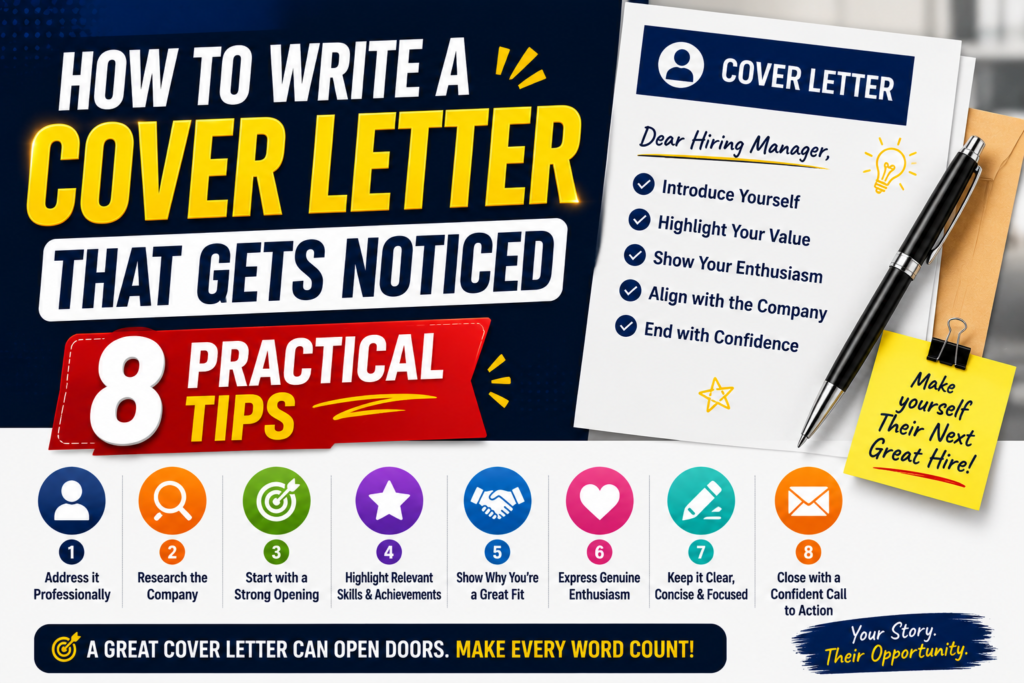
Table of Contents
Quick Overview: What Actually Makes a Cover Letter Stand Out
| Factor | Why It Matters |
|---|---|
| A specific, genuine opening | Generic openers get skimmed and forgotten instantly |
| Evidence, not just enthusiasm | Recruiters want proof you can do the job, not just that you want it |
| Clear connection to the role | Shows you’ve actually read the job description, not mass-applied |
| Concise length | A cover letter is a preview, not a second resume |
| Natural, conversational tone | Overly formal, stiff language reads as impersonal |
| No repetition of your resume | The cover letter should add context, not duplicate content |
Why Most Cover Letters Get Ignored
Recruiters read an enormous number of cover letters that all sound identical, “I am a hardworking and dedicated professional excited to apply for this role.” None of this tells them anything they couldn’t have guessed on their own. A cover letter that gets noticed does the opposite: it gives the recruiter something specific, something they haven’t already read a hundred times that week, and something that connects directly to why you, specifically, are a strong fit for this exact role.
This doesn’t require creative genius. It requires treating the cover letter as an actual piece of communication meant for one specific reader, rather than a formality to get past before submitting your resume.
Step 1: Open With Something Specific, Not Generic
Skip the standard opening line entirely. Instead of “I am writing to apply for the position of X,” start with something that immediately signals genuine interest or relevant context. This could be a specific reason you’re drawn to the company, a direct connection between your background and the role, or even a brief, relevant achievement.
For example, rather than a generic opener, something like “When I saw this role focused on improving customer onboarding, it immediately connected with the work I did redesigning our support team’s onboarding flow last year, which cut resolution time by 30%” gives the recruiter something concrete and memorable within the first two lines.
Step 2: Show You’ve Actually Researched the Role and Company
One of the fastest ways to signal a mass-applied, copy-paste cover letter is vague, interchangeable language that could apply to literally any company in the industry. A cover letter that gets noticed demonstrates that you’ve read the specific job description and understand something real about the company you’re applying to.
This doesn’t require deep research. Even a single specific detail, a recent product launch, a stated company value, or a particular responsibility mentioned in the listing, referenced naturally in your letter, makes a meaningful difference in how genuine your interest appears.
Step 3: Focus on Value, Not Just Enthusiasm
Enthusiasm alone doesn’t convince a recruiter you can do the job well. What convinces them is evidence, brief, specific examples of relevant skills or achievements that directly relate to what the role requires.
Rather than writing “I am passionate about software development and eager to contribute,” a stronger approach connects a specific skill directly to a specific outcome: “In my previous role, I optimized a data processing pipeline that reduced processing time by 40%, a skill I’d bring directly to the performance challenges this role is focused on solving.”
Step 4: Don’t Repeat Your Resume, Add Context to It
A common mistake is treating the cover letter as a narrative version of the resume, restating the same job titles, dates, and bullet points in paragraph form. This wastes an opportunity. The cover letter’s real value is in providing context your resume can’t, why you made a particular career move, what specifically draws you to this role, or how a particular experience shaped your approach to your work.
Think of your resume as the “what” and your cover letter as the “why.” They should complement each other, not duplicate each other. For additional perspective on this distinction, career resources like the <a href=”https://www.ncs.gov.in” rel=”dofollow” target=”_blank”>National Career Service portal</a> also offer general guidance on how application documents should work together rather than repeat each other.
Step 5: Keep It Concise
A cover letter that gets noticed is rarely a long one. Most effective cover letters run three to four short paragraphs, easily readable within 30 to 45 seconds. Recruiters are unlikely to read a dense, lengthy letter in full, and a bloated cover letter often signals an inability to communicate concisely, which itself can work against you.
A useful structure to aim for:
- Opening paragraph: A specific, genuine hook connecting you to the role
- Middle paragraph(s): One or two concrete examples demonstrating relevant value
- Closing paragraph: A clear, confident close, reiterating interest and inviting next steps
Step 6: Write in a Natural, Conversational Tone
Many cover letters read as overly stiff and formal, filled with phrases like “I would be honored to have the opportunity to contribute my skills.” This kind of language creates distance rather than connection. Writing the way you’d actually speak to a professional colleague, clear, respectful, but natural, tends to come across as far more genuine and memorable.
A simple test: read your cover letter out loud. If it sounds like something you’d never actually say to a person, it’s worth rewriting in plainer language.
Step 7: End With Confidence, Not Desperation
The closing paragraph matters more than most candidates realize. Avoid overly passive or apologetic closings like “I hope you will consider my application despite my limited experience.” Instead, close with a clear, confident statement of interest and an invitation to discuss further, without sounding presumptuous.
Something like “I’d welcome the opportunity to discuss how my experience in X can contribute to your team’s goals” closes on a note of quiet confidence rather than uncertainty.
Step 8: Proofread as Carefully as Your Resume
A cover letter with typos or grammatical errors undermines the same credibility you’re trying to build, sometimes even more than a resume error would, since a cover letter is meant to showcase your communication skills directly. Read it slowly, ideally out loud, and if possible, have someone else review it before you submit.
Cover Letter Structure at a Glance
| Section | Purpose | Approximate Length |
|---|---|---|
| Opening Hook | Grab attention with something specific and genuine | 1 to 2 sentences |
| Value Paragraph(s) | Demonstrate relevant skills with concrete examples | 2 to 4 sentences |
| Company Connection | Show genuine understanding of the role/company | 1 to 2 sentences |
| Closing | Confident, clear call to action | 1 to 2 sentences |
Common Cover Letter Mistakes to Avoid
- Starting with a generic, overused opening line
- Simply restating your resume in paragraph form
- Using overly formal, stiff language that doesn’t sound like you
- Writing a cover letter so long it’s unlikely to be read in full
- Failing to mention anything specific about the company or role
- Sending the same cover letter to every application without any tailoring
- Leaving in typos, grammatical errors, or the wrong company name from a previous application
Cover Letter Checklist Before You Send It
- Opening line is specific, not generic
- At least one concrete example demonstrates relevant value
- Content adds context beyond what’s already in the resume
- Tone reads as natural, not overly formal or stiff
- Length is concise, ideally under half a page
- Closing paragraph is confident, not apologetic
- Company name and role title are correct throughout
- No typos or grammatical errors remain
Who This Guide Is Especially Useful For
This approach is particularly valuable if you’re applying to roles that explicitly request a cover letter, competing for positions with a high volume of applicants, or trying to explain a career transition, employment gap, or unconventional background that a resume alone doesn’t fully capture. It’s also useful for freshers, since a well written cover letter can help compensate for limited work experience by clearly communicating motivation and transferable skills.
Related Reads on FreshJobSeekers
- Deloitte USI Recruitment 2026: Intela Support Associate Services Specialist I, Hyderabad
- Wipro Graduate Engineer Trainee Recruitment 2026: Freshers Can Apply
- Microworkers.com Review: What India Based Users Should Actually Expect
- Frontier Customer Support Representative: Remote Overnight Project Role Explained
- Startek Zomato WFH Customer Support Executive: Chat and Voice Process Hiring
click here
Frequently Asked Questions About How to Write a Cover Letter That Gets Noticed
1. Is a cover letter still necessary in 2026?
Yes, many employers still request one, and even when optional, a well written cover letter can meaningfully strengthen an application, especially for competitive roles.
2. How long should a cover letter be?
Ideally under half a page, roughly three to four short paragraphs that can be read within about 30 to 45 seconds.
3. Should I use the same cover letter for every job application?
No, tailoring key details, particularly the opening hook and the connection to the specific role, meaningfully improves how genuine and relevant your letter appears.
4. What’s the biggest mistake people make in cover letters?
Simply restating their resume in paragraph form instead of adding new context about their motivation, fit, or specific relevant achievements.
5. Should a cover letter be formal or conversational in tone?
A natural, professional, conversational tone generally reads better than overly stiff, formal language, as long as it remains respectful and appropriate for a professional context.
6. Do freshers need a cover letter if they don’t have much work experience?
Yes, a cover letter can be especially useful for freshers, since it allows you to communicate motivation, transferable skills, and relevant academic projects that a thin resume might not fully capture.
7. How do I start a cover letter without sounding generic?
Open with something specific, a genuine connection to the role, a relevant achievement, or a specific detail about the company, rather than a standard “I am writing to apply” line.
8. Should I mention salary expectations in a cover letter?
Generally no, unless the job posting specifically asks for this information upfront.
9. Is it okay to use a cover letter template?
A template can be a useful starting structure, but the actual content should be genuinely tailored to each specific application rather than left generic.
10. What should the closing paragraph of a cover letter include?
A clear, confident statement of interest and an invitation to discuss further, without sounding passive or overly apologetic.
11. Should I address my cover letter to a specific person?
Where possible, yes. Addressing a specific hiring manager or recruiter by name, if you can find it, generally comes across as more personal and genuine than a generic “To Whom It May Concern.”
12. Can a strong cover letter make up for a weaker resume?
It can help provide context and demonstrate communication skills, but it generally works best as a complement to a solid resume, not a replacement for one.
Final Thoughts
Learning how to write a cover letter that gets noticed really comes down to treating it as genuine, specific communication rather than a formality. A strong opening hook, concrete evidence of relevant value, a natural tone, and a confident close will consistently outperform a generic, resume-repeating letter sent to every employer. It takes a bit more effort per application, but for roles you genuinely want, that extra effort is usually well worth it.
Disclaimer
This article has been published by FreshJobSeekers for general informational and educational purposes only. It reflects general best practices for cover letter writing based on widely recognized hiring and recruitment patterns, and is not a guarantee of interview calls, shortlisting, or job offers. Individual results will vary based on factors such as industry, role, employer preferences, and overall application strength, many of which are outside the scope of this guide.
FreshJobSeekers is not affiliated with any specific recruitment platform or employer mentioned or implied in this article. We do not guarantee that following this guide will result in any specific hiring outcome. Readers are encouraged to adapt the suggestions here to their own industry, experience level, and the specific expectations of the roles they are applying for. We do not charge any fee for the career guidance published on this site.